But you seem to ignore the fact that Gaddafi had a well armed military that was used with some success- and indeed ignited the armed-rebellion by killing 150 peaceful protesters.
On the first day of protest, the numbers went from 200 people to 600 people. The protests became rowdy, police forcefully (and yes, violently) intervened, there were several dozen injuries (40 in all), but not a single protestor was killed. Later that day,
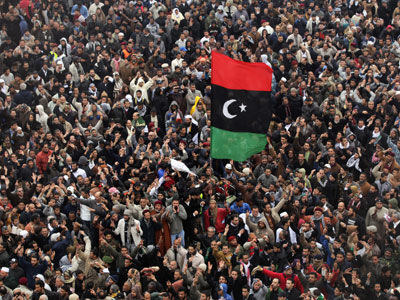
several police stations and other government buildings were burned to the ground by these protesters. The following day, protests continued in Benghazi, police attempted to disperse the crowds with water cannons, but eventually retreated. Protestors then
burned down the local traffic office, as well as a few cars. The 'day of revolt', the 17th in which you seem to suggest 150 peaceful protestors were killed, commemorated a day of protest of Jyllands-Posten for drawing some Muhammad cartoons. Amnesty international stated that this was around the time Gaddafi started hiring mercenaries to execute Libyans, but that has since proven to be a rumor with no evidential basis, as now openly admitted by Amnesty. None the less, several people were shot, and though the Gaddafi administration insists it was pro-Gaddafi protestors being shot at and killed, the story as we know it is that it was the police shooting anti-Gaddafi protestors. 15 people were said to have been shot in Benghazi, and an additional 16 in other regions.
Police stations and other unaffiliated buildings continued to be burned down.
The following day, there are unconfirmed reports that riot police had started joining the rebels, but its unquestionable that at least
two police officers, accused of shooting protesters,
were lynched. On that same day,
50 Africans were
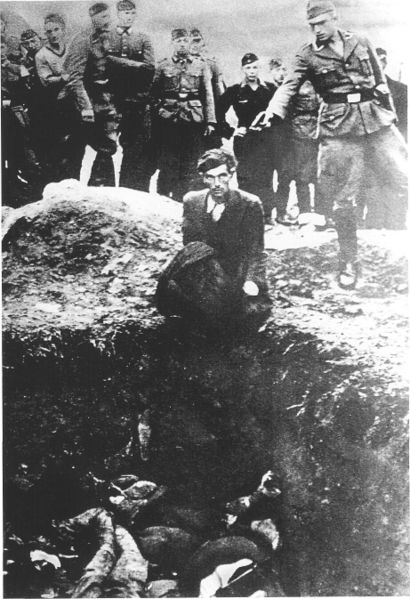
murdered and mutilated by these protestors, on the claim they were mercenaries. There is no substantial evidence mercenaries were being hired by Gaddafi. All the current evidence suggests these were just black people who happened to be on the airfield at the wrong time. An undocumented number of other 'conspirators' were also apparently locked in the cells of a police station which was subsequently burned down with them inside. Both of these events were referred too as 'executions'.
All of this occurred in
the first three days of protest. If this is your idea of a 'peaceful protest', we're on entirely separate pages. This sounds to me like a Government struggling, undoubtedly violently, to quell an outbreak of anarchistic rebel behavior. There were legitimate attempts to appease the protestors as well, over a hundred prisoners were released in these early days in an effort to calm the violence, but it only rapidly escalated. By the 19th, the country-wide deathtoll was estimated at 109 people by Human Rights Watch. That would suggest that at least as many people had been killed by the protesters as protesters had been killed themselves.
Gaddafi attacked his own people using tanks, planes and artillery for over a month before NATO planes flew. It wasn't until he had surrounded Benghazi and was about to attack the people there that NATO took action.
Islamic extremist elements had seized Benghazi (a coastal city) and were burning down government buildings, killing government employees, and generally terrorizing those locals who didn't support them. Gaddafi intended to use military action to retake the city. I'm not saying what Gaddafi and the military did was 'right', but it's not exactly unprecedented or unexpected given the circumstances. Just a nation struggling to handle its own internal strife by questionable means, as happens all around the world/is happening currently in several African nations without any foreign intervention.
You seem to discounting the brutal legacy Gaddafi had with his own people during his 40+yrs reign and the genuine desire for change by a great number of his people.
Not in the slightest. Gaddafi wasn't a nice guy. But keep in mind many of the human rights abuses during his rule were at the 'state' level, committed by his 'Revolutionary Committees', sort of a communist equivalent to state/provincial government. He actually decried many of the crimes perpetrated by these Committees, his rule of the nation supposedly symbolic in nature (like the queen of England), and worked to pass laws expanding personal freedoms in Libya in the wake of them. Were his hands clean? Not a snowball's chance in hell. But his human rights abuses are hardly uncommon or unique. Compared to a place like Saudi Arabia, pre-uprising Libya would probably have seemed like a liberal haven, but then nobody talks about how absolutely messed up Saudi Arabia and how it treats its people is, because they're a long-standing business partner.
You cling to this highly dubious 25% number as if it means something...all the while ignoring the other 75%. The desire for changes can be evidenced by all the defections that took place almost immediately and throughout the conflict- from high ranking officials, diplomats to entire army brigades. Many before ANY NATO bombs fell. Even his own UN ambassador urged him to step-down. Read this report 5 days after the rebellion started. Does this sound like he had a lot of support?
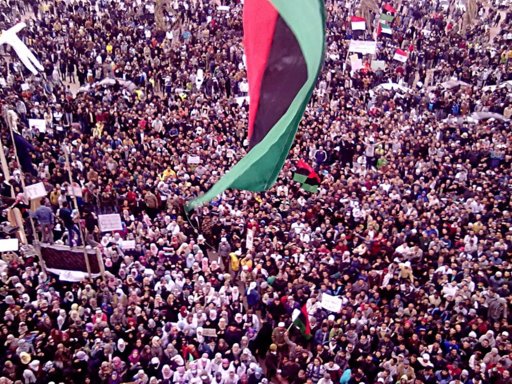
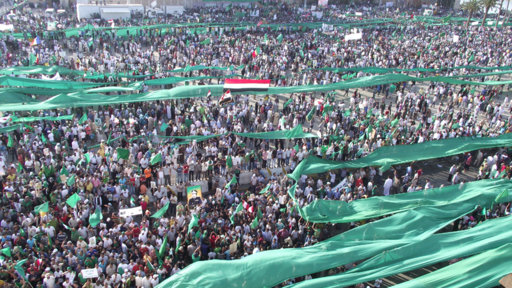
I'm hardly 'clinging' too it, I myself stated I couldn't confirm it. Still, if it was even close to that number, isn't it rather telling? The protest which sparked this whole event started with no more than 600 people. It rose from there to 'tens of thousands', some reports even state that Benghazi eventually housed as much as 'a hundred thousand' anti-Gaddafi 'protesters', though at that point its far more accurate to call them Rebels. So you've got a reported 1.7 million people (give or take) engaging in actual peaceful protest, and a hundred-thousand (give or take) people engaging in anarchistic protest actions. You say I'm treating the 25% as though it outweighs the 75%... why does the 1-10% outweigh the 99-80% so much as to warrant full international military support? Are you aware that a majority of the troop defections were reported by a rebel-controlled media-outlet, and that most are entirely unconfirmed by outside sources? It's true, many officials resigned and decried Gaddafi when it was clear which way the wind was blowing, but many of these were high-ranking members of Revolutionary Committees that often were already at odds with Gaddafi, as state/provincial representatives often are at odds with their administrations.
NATO had no tanks or ground forces in Libya. Rebels did capture tanks and acquire them through defections.
http://www.youtube.com/watch?v=ANWG_dCAXII ,
http://www.liveleak.com/view?i=894_1320340656 <- an armed American fighting in Libya. 'Just a reporter', apparently, who decided to take up arms. From what I recall about investigative journalism of war-zones, you don't typically pick up a gun and start shooting at people unless your life is in the most immediate peril. The guy seems pretty calm and relaxed to me. You also don't typically direct forces as a journalist.
http://www.youtube.com/watch?v=JI-nQx6rPgM a fellow wearing helmet and body-armor in the style of European NATO forces present at the lynching of Gaddafi. No proof he's NATO, but he certainly looks the part. Were you aware that the lynching of Gaddafi, as well as the 60 people in his convoy, is being investigated as a War Crime? A Canadian citizen who worked as a Bodyguard for the Gaddafi family has just been judged as 'Culpable for the crimes of the Gaddafi regime' and is being expelled from the country for participating in efforts to rescue his wife and son from an equally gruesome fate. Despicable shit, so far as I'm concerned.
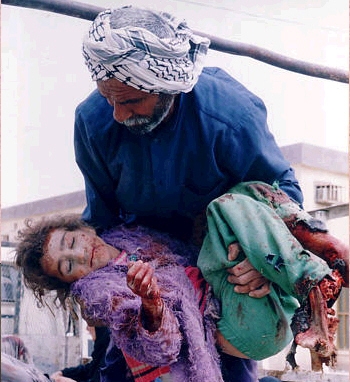
War is hell. People are cruel. Libya is not exempt from the brutality and callousness of Man. What is your point? That its NATO's fault that that Libyans beheaded other Libyans?
my point is that NATO acted in heavy support of an extremist movement that was by no means 'the majority', an extremist movement that lead to many countless unspeakable crimes and a devastating bombing campaign, and has left the country in such an unstable state that America couldn't even protect its own embassy there. Islamic extremism, once at the fringe of Libyan society, is now one of the dominant forces in the country, which has turned a country once relatively tolerant of its ethnic minorities into a xenophobe state where black people are routinely abused, discriminated against, or murdered.
NATO's actions were not for the good of the Libyan people. Surely you must see that.
but the real problem is the lack of diversity in the Iraqi economy
Right. Countless bombs dropped, countless families destroyed, countless businesses brought to an abrupt end, countless children growing up in fear of the sky, hatred of the west, and/or stark distrust of their neighbors.... but the REAL problem is a lack of economic diversity, and that's got nothing to do with the campaign.




 .
.