Results 1 to 16 of 16

Thread: Contrail from just one engine

  1. #1
    Administrator Mick's Avatar
    Join Date
    Dec 2010
    Location
    Los Angeles
    Posts
    8,020
    Thanks
    185
    Thanked 1,557 Times in 1,036 Posts
    Blog Entries
    4

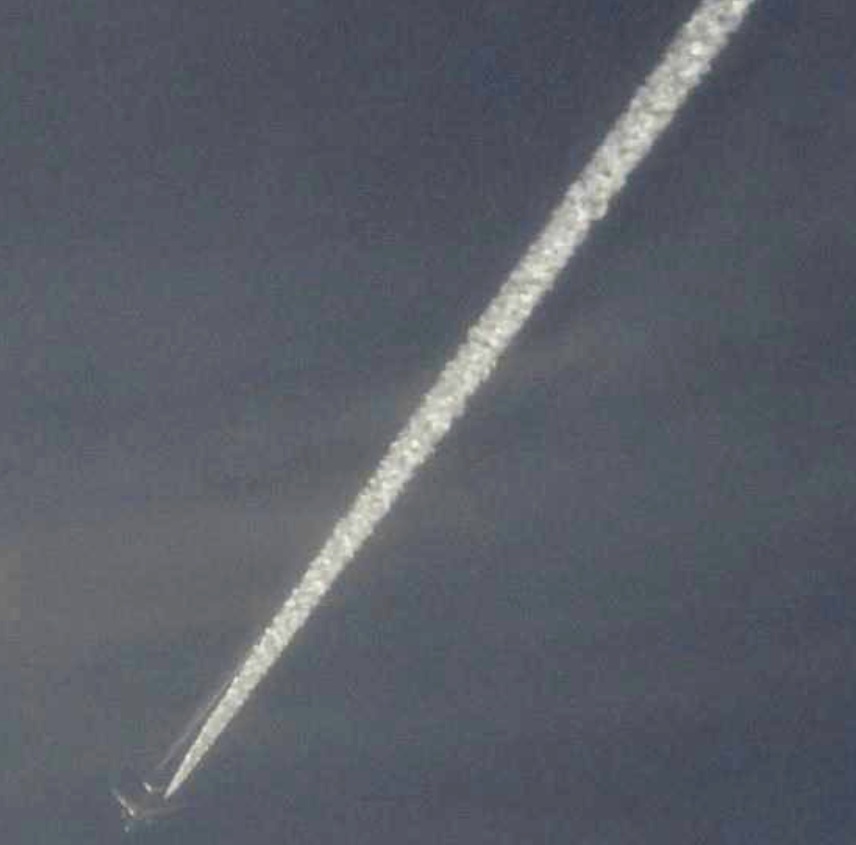
    Contrail from just one engine

    Posted on Facebook, apparently from yesterday, maybe Montana.


    Looks like one engine is out. But there's a faint trail coming from the port engine. What might that be? Residual fuel leak? Aerodynamic? Engine is just on the lowest power setting?

  2. #2
    Senior Member MikeC's Avatar
    Join Date
    Jan 2011
    Posts
    1,754
    Thanks
    194
    Thanked 363 Times in 251 Posts
    Conceivably one engine out, or one engine running at a significantly different EGT margin to the other.

    From the small wispy trail if I had to guess I would guess the later - the port engine is running right at the "edge" of contrail producing parameters whereas the starboard one is clearly inside them. But that is just a guess.

    What it pretty clearly is not is camera angle obfuscating or combining 2 contrails into one as somethings happens, nor does it appear to be a tail engined aircraft where the contrails combine almost immediately they form - these might seem obvious but I figure it's usually a good idea to mention the obvious at least once
    "Men never do evil so completely and cheerfully as when they do it from religious conviction." -Pascal
    "It is very important not to mistake hemlock for parsley; but not at all so to believe or not in God" - Diderot

  3. #3
    Administrator Mick's Avatar
    Join Date
    Dec 2010
    Location
    Los Angeles
    Posts
    8,020
    Thanks
    185
    Thanked 1,557 Times in 1,036 Posts
    Blog Entries
    4
    Yeah, if it is marginal contrail conditions, then and EGT (Exhaust Gas Temperature) of a few degrees higher could mean the mixing line never goes though the water supersaturate region, and contrails will never - or barely - form.

    It's a pity there isn't a longer video where you could see if it came back on, or if the other one went off.

  4. #4
    Moderator George B's Avatar
    Join Date
    Feb 2012
    Location
    Texas, SC, Tennessee
    Posts
    3,612
    Thanks
    214
    Thanked 209 Times in 170 Posts
    Quote Originally Posted by Mick View Post
    Posted on Facebook, apparently from yesterday, maybe Montana.


    Looks like one engine is out. But there's a faint trail coming from the port engine. What might that be? Residual fuel leak? Aerodynamic? Engine is just on the lowest power setting?
    Hmmmm . . . Have never seen this situation before. . . Probability of this is rather low. . . .
    The only thing guaranteed in life is deception. . . everything else is optional . . . George B

  5. #5
    Member PCWilliams's Avatar
    Join Date
    Nov 2011
    Location
    North Carolina
    Posts
    421
    Thanks
    153
    Thanked 67 Times in 51 Posts
    Quote Originally Posted by Mick View Post
    Yeah, if it is marginal contrail conditions, then and EGT (Exhaust Gas Temperature) of a few degrees higher could mean the mixing line never goes though the water supersaturate region, and contrails will never - or barely - form.

    It's a pity there isn't a longer video where you could see if it came back on, or if the other one went off.
    We don't know the stage of flight. The aircraft could have just been given a clearance to reduce/increase speed and what we're seeing is a speed transition and the engines are not quite in sync.

  6. #6
    Administrator Mick's Avatar
    Join Date
    Dec 2010
    Location
    Los Angeles
    Posts
    8,020
    Thanks
    185
    Thanked 1,557 Times in 1,036 Posts
    Blog Entries
    4
    Quote Originally Posted by George B View Post
    Hmmmm . . . Have never seen this situation before. . . Probability of this is rather low. . . .
    Right, which is why you hardly ever see it. And when you do see it it looks remarkable.

    Given that's there's 30,000 commercial flights per day, something with a 1 in a million chance of happening on any given flight will happen ten times a year, somewhere in the US.

    How remarkable is it, exactly? 1 in 10,000 flights? 1 in 100,000?

    http://www.consumertraveler.com/toda...gine-problems/
    Quote Content from external source:

    Averaged over the last eight months, American Airlines has had planes experience three engine failures per month — far more than any other domestic airline.

    During that eight-month period, FAA records showed American had 23 failures, Delta had 17, United 15, US Airways 10, Continental 10, Southwest seven and Northwest seven.

  7. #7
    Senior Member Jay Reynolds's Avatar
    Join Date
    Feb 2011
    Location
    Arkansas
    Posts
    2,415
    Thanks
    47
    Thanked 727 Times in 433 Posts
    insufficient data

    The observer is to blame, but the chemtrails activist community has not sought to apply the tech which could resolve many of these questions:
    http://metabunk.org/threads/100-14-Y...nd-Suggestions
    "A lie can travel halfway around the world while the truth is putting on its shoes." ...Mark Twain

  8. #8
    Member PCWilliams's Avatar
    Join Date
    Nov 2011
    Location
    North Carolina
    Posts
    421
    Thanks
    153
    Thanked 67 Times in 51 Posts
    Quote Originally Posted by Jay Reynolds View Post
    insufficient data

    The observer is to blame, but the chemtrails activist community has not sought to apply the tech which could resolve many of these questions:
    http://metabunk.org/threads/100-14-Y...nd-Suggestions
    Following your links Jay, i wound up at this page: Contrail pictures of three engined airliners

    In many of these pictures the center engine is not producing a contrail.

  9. #9
    Administrator Mick's Avatar
    Join Date
    Dec 2010
    Location
    Los Angeles
    Posts
    8,020
    Thanks
    185
    Thanked 1,557 Times in 1,036 Posts
    Blog Entries
    4
    Quote Originally Posted by PCWilliams View Post
    Following your links Jay, i wound up at this page: Contrail pictures of three engined airliners

    In many of these pictures the center engine is not producing a contrail.
    Or not appearing to at least. In several photos the contrail would be off the side of the photo, or lined up with another contrail.

    It does not seem like there's a great practical reason to have three engines though. I wonder if the third engine was treated significantly differently to the main two.

    http://en.wikipedia.org/wiki/Trijet
    Quote Content from external source:

    Early twin-jet designs were limited by the FAA's "60-minute rule", whereby the flight path of twin-engined jetliners was restricted to within 60 minutes' flying time from a suitable airport, in case of engine failure. In 1964 this rule was lifted for trijet designs, as they had a greater safety margin. This led to a flurry of trijet designs, which by 1980 had become the most popular airliner configuration.

  10. #10
    Member PCWilliams's Avatar
    Join Date
    Nov 2011
    Location
    North Carolina
    Posts
    421
    Thanks
    153
    Thanked 67 Times in 51 Posts
    Quote Originally Posted by Mick View Post
    Or not appearing to at least. In several photos the contrail would be off the side of the photo, or lined up with another contrail.

    It does not seem like there's a great practical reason to have three engines though. I wonder if the third engine was treated significantly differently to the main two.

    http://en.wikipedia.org/wiki/Trijet
    Quote Content from external source:

    Early twin-jet designs were limited by the FAA's "60-minute rule", whereby the flight path of twin-engined jetliners was restricted to within 60 minutes' flying time from a suitable airport, in case of engine failure. In 1964 this rule was lifted for trijet designs, as they had a greater safety margin. This led to a flurry of trijet designs, which by 1980 had become the most popular airliner configuration.
    If i remember correctly from my one time flying in the cockpit of a DC-10, once at cruise, they pulled back on the center engine.

  11. #11
    Member TWCobra's Avatar
    Join Date
    Feb 2012
    Location
    Sydney
    Posts
    297
    Thanks
    21
    Thanked 139 Times in 75 Posts
    Sorry, but they would not do that. If an airliner has three engines then it needs the thrust from all three for normal operations.

  12. #12
    Administrator Mick's Avatar
    Join Date
    Dec 2010
    Location
    Los Angeles
    Posts
    8,020
    Thanks
    185
    Thanked 1,557 Times in 1,036 Posts
    Blog Entries
    4
    Quote Originally Posted by TWCobra View Post
    Sorry, but they would not do that. If an airliner has three engines then it needs the thrust from all three for normal operations.
    But does the trust from all three need to be the same? All three engines do not need to operate at full power during normal cruise speed. Or more specifically, does the exhaust gas temperature of the middle engine need to be the same as for the wing engines?

  13. #13
    Senior Member MikeC's Avatar
    Join Date
    Jan 2011
    Posts
    1,754
    Thanks
    194
    Thanked 363 Times in 251 Posts
    I know that Maritime patrol aircraft often throttle back or even shut down 1 engine on each wing when patrolling (from ex P3 pilots I have worked with). There woudl be good economic erasons for not running 1 engine if you could do so - engine hours are the prime determinate of engine wear and maintenance requirements.

    That said shutting down an engine risks it not restarting (as often happens with APU's and is a significant problem for ETOPS/EDTO that rely upon the APU as an additional soutrce of electrics, hydraulics and air - they have to do restarts at cruise altitudes to check reliability and report all failures)

    However I also work with some older pilots who flew Air NZ DC-10's and they tell me they never shut down the middle engine, nor throttled it any differently to the other 2 - whatever thrust was required was achieved from all engines. Now that's not a large sample - possibly other airlines did differently, possibly the USAF does differently with KC-10's.
    "Men never do evil so completely and cheerfully as when they do it from religious conviction." -Pascal
    "It is very important not to mistake hemlock for parsley; but not at all so to believe or not in God" - Diderot

  14. #14
    Member TWCobra's Avatar
    Join Date
    Feb 2012
    Location
    Sydney
    Posts
    297
    Thanks
    21
    Thanked 139 Times in 75 Posts
    All three engines are the same and interchangeable. All engines on all multi engine aircraft are the same. If they are there, they are required for normal ops. The P3 did shut down engine 1 for low altitude loiter ops, but always fired it back up again for climb and cruise.
    Having said that, all multi engine AC must be capable of losing one engine at any time after the V1 call on takeoff, but that is a non normal operation. Engines and their ancillaries cost and weigh too much to have an extra on the airframe that is not required.

  15. #15
    Senior Member MikeC's Avatar
    Join Date
    Jan 2011
    Posts
    1,754
    Thanks
    194
    Thanked 363 Times in 251 Posts
    Yep. Eg when I worked on BAe-146's (no truth in the rumour that BAe stood for "Bring Another engine...) there was a "3-engine ferry" procedure in the manual so that if an engine became unserviceable it could be locked (stopped from rotating to prevent further damage) and the aircraft flown back to a maintenance base (without pax or freight on board!) for replacement. I remember the delight when the Engineering Mgmt realised this (I was QA auditor at the time) - after having to apply for "Special Flight Permits" to do so on a few previous occasions because they hadn't realised it was a "normal" procedure
    "Men never do evil so completely and cheerfully as when they do it from religious conviction." -Pascal
    "It is very important not to mistake hemlock for parsley; but not at all so to believe or not in God" - Diderot

  16. #16
    Member TWCobra's Avatar
    Join Date
    Feb 2012
    Location
    Sydney
    Posts
    297
    Thanks
    21
    Thanked 139 Times in 75 Posts
    http://avherald.com/h?article=44f9832e&opt=0

    This is not the actual incident because it is the wrong engine, but otherwise the photo fits this. Loss of engine at cruising (read possible contrail altitude) and even fuel dumping as a possible explanation for the smaller trail.
    This sort of thing happens regularly. Avherald is a great source of up to date events.

Bookmarks

Posting Permissions

  • You may not post new threads
  • You may not post replies
  • You may not post attachments
  • You may not edit your posts
  •  
Gravatar as Default Avatar by 1e2.it