

History of the Term "Conspiracy Theory"
The term "conspiracy theory" is used to describe any theory that attempts to characterize observed events as the result of some secret conspiracy. The term is often used dismissively, implying that the theory is implausible.
Although conspiracy theories (particularly aimed at Jews and Bankers) date back hundreds of years, the earliest usage of "conspiracy theory" do not always have this connotation, although the theories are quite often dismissed in other ways. Usually it's simply a way of identifying the theory from other theories - as in "the theory that happens to have a conspiracy"
The first usage I could find was from 1870, The Journal of mental science: Volume 16 - Page 141
http://books.google.com/books?id=ziIgAQAAMAAJ&dq="conspiracy theory"&pg=PA608-IA7#v=onepage&q="conspiracy theory"&f=false
http://books.google.com/books?id=f9ghAQAAMAAJ&dq="conspiracy theory"&pg=PA394#v=onepage&q="conspiracy theory"&f=false
http://books.google.com/books?id=GkIxAQAAMAAJ&dq="conspiracy theory"&pg=RA16-PA27#v=onepage&q="conspiracy theory"&f=false
Given the multiple usages on the subject of succession, it seems plausible that this is a key point in the evolution of the phrase. It shifts from simple incidental use in language to referring to a specific thing. From "that theory which has a conspiracy" to "the theory that we call conspiracy theory"
1899, this is more like it, from an article discussing various conspiracy theories regarding South Africa. And an early debunking:
http://books.google.com/books?id=cHdNAAAAYAAJ&dq="conspiracy theory"&pg=PA227#v=onepage&q="conspiracy theory"&f=false
Some people get a bit upset when you use the term "conspiracy theory", so I think it's good to be clear on what you mean. One might say "I know it when I see it", like say 9/11 no-plane theories, or fake moon-landing theories. I think Aaronovitch has something right here:
Aaronovitch, David (2010-01-19). Voodoo Histories: The Role of the Conspiracy Theory in Shaping Modern History (pp. 5-6). Penguin Group. Kindle Edition.
One 1962 reference is:
Walter Wilcox. "The Press of the Radical Right: An Exploratory AnalysisJournalism & Mass Communication Quarterly - Walter Wilcox, 1962." Journals.sagepub.com, http://journals.sagepub.com/doi/pdf/10.1177/107769906203900202. Accessed 26 Aug. 2017.
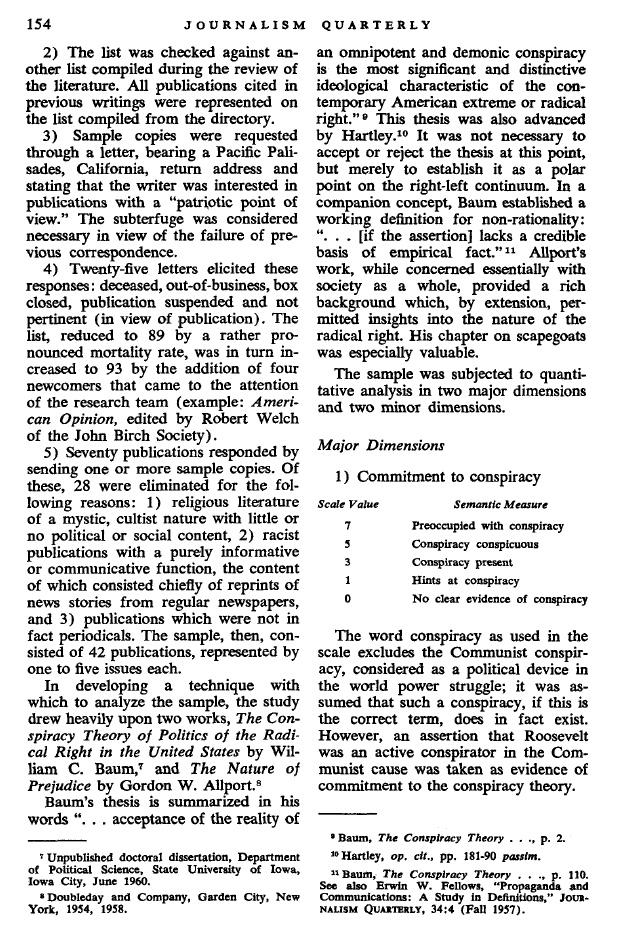
http://www.worldcat.org/title/consp...ical-right-in-the-united-states/oclc/18821548
Looking at this list of dissertation theses:
http://crws.berkeley.edu/sites/default/files/shared/docs/ACADEMIC Theses & Dissertations Biblio 10-10-13.pdf
there's lots of entries like:
1950. In which he writes:
http://archive.harpers.org/1964/11/pdf/HarpersMagazine-1964-11-0014706.pdf?
CIA Memo: http://www.jfklancer.com/CIA.html
The term "conspiracy theory" is used to describe any theory that attempts to characterize observed events as the result of some secret conspiracy. The term is often used dismissively, implying that the theory is implausible.
Although conspiracy theories (particularly aimed at Jews and Bankers) date back hundreds of years, the earliest usage of "conspiracy theory" do not always have this connotation, although the theories are quite often dismissed in other ways. Usually it's simply a way of identifying the theory from other theories - as in "the theory that happens to have a conspiracy"
The first usage I could find was from 1870, The Journal of mental science: Volume 16 - Page 141
1890 - Some kind of political conspiracy, mostly ridiculedExternal Quote:The theory of Dr. Sankey as to the manner in which these injuries to the chest occurred in asylums deserved our careful attention. It was at least more plausible that the conspiracy theory of Mr. Charles Beade, and the precautionary measure suggested by Dr. Sankey of using a padded waistcoat in recent cases of mania with general paralysis—in which mental condition nearly all these cases under discussion were—seemed to him of practical value.
http://books.google.com/books?id=ziIgAQAAMAAJ&dq="conspiracy theory"&pg=PA608-IA7#v=onepage&q="conspiracy theory"&f=false
Here from a review of theories about the causes of the secession of the South, 1895.External Quote:The conspiracy theory may be well founded, but then again it may not. And rather than be dependent upon the evidence of it which may be furnished through the self-sacrificing efforts of the gentlemen who are so ardently engaged in that behalf, we should rather see the party stand on its own foundation, and Mr. Quay on his record, whatever it may be. Then the plot might be proved or disproved, and still the party could live for the further service of the country.
http://books.google.com/books?id=f9ghAQAAMAAJ&dq="conspiracy theory"&pg=PA394#v=onepage&q="conspiracy theory"&f=false
Also on the same topic 1895External Quote:Mr. Rhodes discards the theory prevalent at the North, that secession was the outcome of a conspiracy of Southern Senators and Representatives at Washington, and adopts the view expressed by all Southern writers except Pollard, that secession was a popular movement. As a matter of fact, the Southern leaders in Congress were pressed onward by their constituents. Davis and Toombs are classed among the conspirators. Yet Davis was in favor of delay, and Toombs, in spite of his vehement language at Washington, could not keep pace with the secession movement in his State; while the South Carolina radicals murmured that the people were hampered by the politicians. The conspiracy theory is based on a misconception
http://books.google.com/books?id=GkIxAQAAMAAJ&dq="conspiracy theory"&pg=RA16-PA27#v=onepage&q="conspiracy theory"&f=false
External Quote:
NORTHERN writers generally hold that secession was the work of a. conspiracy of Southern Senators and Representatives at Washington, who "dictated the inception and course of the revolution." On the other hand, all Southern writers, except Pollard, maintain that secession was a distinctly popular movement. Northern writers instance the meeting held at Washington january 5, 1861, by the Senators from Georiga, Alabama, Louisiana, Texas, Mississippi, and Florida, which, with South Carolina. formed the seven original States of the Confederacy. " In effect," says Blaine, in his "Twenty Years of Congress" (Vol. I., p. 220) , these Senators "sent out commands to the governing authority and to the active political leaders, that South Carolina [which had already seceded] must be sustained: that the Cotton States must stand by her; and that the secession of each and every one of them must be accomplished . . . before the inauguration of Mr. Lincoln." If from this the conclusion be drawn that the Southern leaders, after having dragooiied the Southern people into secession, maintained the ensuing war by arbitrary suppression of public sentiment and by forcible appropriation of men and supplies, it will be difficult to reconcile such a conclusion with what the same writers say of the conduct of the Southern troops during the war and of the devotion of the non-combatants, especially of the women, to the cause of secession. The contention, on the other hand, that secession was a popular movement supposes that practically the whole of the Southern people, "mean whites" as well as slave-owners, believed that slavery was sanctioned by the Scriptures, that their material prosperity depended on slavery, that this institution was threatened by the election of a Republican President, and that a constitutional remedy was afforded by secession. It is interesting, in view of this conflict of opinion, to note that Mr. james Ford Rhodes, in his " History of the United States" from the Compromise of r850, the complete and scholarly work on this period which has just appeared, discards the conspiracy theory, and adopts the view that secession was a purely popular movement.
Given the multiple usages on the subject of succession, it seems plausible that this is a key point in the evolution of the phrase. It shifts from simple incidental use in language to referring to a specific thing. From "that theory which has a conspiracy" to "the theory that we call conspiracy theory"
1899, this is more like it, from an article discussing various conspiracy theories regarding South Africa. And an early debunking:
http://books.google.com/books?id=cHdNAAAAYAAJ&dq="conspiracy theory"&pg=PA227#v=onepage&q="conspiracy theory"&f=false
Here it's seeming to move towards its current use with an implied "far-fetched" prepended.External Quote:
Mr. Balfour proceeded to discuss one theory of conspiracy and to dismiss another. He tells us that he was a late convert to the doctrine of Dutch megalomania, and that he only accepted it because no other hypothesis could explain the ultimatum. That act made it clear that the Boers were not making a struggle for their independence, but were making a " bold bid for empire." A conspiracy, we are told, is ex hypothesi secret, and you must not expect proofs. Its existence is discovered by a process of elimination. But it may at least be required of a theory of conspiracy that it should be consistent with what is known. Mr. Balf our connects his theory with the armaments of the Boers and the alliance with the Orange Free State. Does that explain the readiness of the Orange Free State to co-operate with the Transvaal in 1881, when the latter had no armaments?
[...]
The other conspiracy theory Mr. Balfour, with an attractive and ingenuous innocence, elaborately misunderstands. Nobody has pretended that either England or Mr. Balfour will make money out of this war. When it is said that avarice is at the bottom of the difficulties in South Africa, we mean the avarice of those financiers who call each other empire-builders, and the growth of their own fortunes the advance of British civilization.
Some people get a bit upset when you use the term "conspiracy theory", so I think it's good to be clear on what you mean. One might say "I know it when I see it", like say 9/11 no-plane theories, or fake moon-landing theories. I think Aaronovitch has something right here:
Aaronovitch, David (2010-01-19). Voodoo Histories: The Role of the Conspiracy Theory in Shaping Modern History (pp. 5-6). Penguin Group. Kindle Edition.
Regarding the theory that the term was invented by the CIA in 1967, it might be useful to gather examples of usage from the decades before, and the decades after. Also an inflection point might be the JFK assassination itself on NOv 22, 1963.External Quote:S
I think a better definition of a conspiracy theory might be "the attribution of deliberate agency to something that is more likely to be accidental or unintended." And, as a sophistication of this definition, one might add "the attribution of secret action to one party that might far more reasonably be explained as the less covert and less complicated action of another." So, a conspiracy theory is the unnecessary assumption of conspiracy where other explanations are more probable. It is, for example, far more likely that men did actually land on the moon in 1969 than that thousands of people were enlisted to fabricate a deception that they did.
One 1962 reference is:
Walter Wilcox. "The Press of the Radical Right: An Exploratory AnalysisJournalism & Mass Communication Quarterly - Walter Wilcox, 1962." Journals.sagepub.com, http://journals.sagepub.com/doi/pdf/10.1177/107769906203900202. Accessed 26 Aug. 2017.
The referenced 1960 work by Baum seems to only exist in a few libraries.External Quote:In developing a technique with which to analyze the sample, the study drew heavily upon two works, The Conspiracy Theory of Politics of the Radical Right in the United States by William C. Baum,
http://www.worldcat.org/title/consp...ical-right-in-the-united-states/oclc/18821548
It is however referenced by many books on conspiracy theories.External Quote:
The conspiracy theory of politics of the radical right in the United States
Author: William Chandler Baum
Publisher: 1960.
Dissertation: Ph. D. State University of Iowa 1960
Looking at this list of dissertation theses:
http://crws.berkeley.edu/sites/default/files/shared/docs/ACADEMIC Theses & Dissertations Biblio 10-10-13.pdf
there's lots of entries like:
Common phrases are "The Conspiracy theory of History" and "The Conspiracy Theory of Politics". Both of these terms seem to most commonly refer to a world-wide Jewish conspiracy (theory) They mostly come after 1963 and 1967, but there's:External Quote:MT Boynorski, Marie Aspects of Populism:' 'The Conspiracy Theory of History— Heroes and Villains of Populism, Anti-semitism in Populism. Queens College—New York 1970, 75pp
This usage of "The conspiracy theory of..." may well date back to Karl Popper in "The Open Society and Its Enemies",External Quote:
Knox, J. Wendell Conspiracy in American Politics 1787-1815 Univ of North Carolina —Chapel Hill 1965, 329pp
Remington, Rodger A. The Function of the Conspiracy Theory in American Intellectual History St. Louis University 1965, 285pp
Mahoney, Michael M. John Stewart Service:''A Chapter in the Diplomacy and Conspiracy Theory of American Policy in China 1943-1951 University of Wyoming 1967, 126pp
It's worth noting the highly influential 1964 essay "The Paranoid Style in American Politics" which, while it does not use the term "conspiracy theory" still uses the word "conspiracy" in the context of this "paranoid style".External Quote:
In order to make my point clear, I shall briefly describe a theory which is widely held but which assumes what I consider the very opposite of the true aim of the social sciences; I call it the ''conspiracy theory of society'. It is the view that an explanation of a social phenomenon consists in the discovery of the men or groups who are interested in the occurrence of this phenomenon (sometimes it is a hidden interest which has first to be revealed), and who have planned and conspired to bring it about. This view of the aims of the social sciences arises, of course from the mistaken theory that, whatever happens in society—especially happenings such as war, unemployment, poverty, shortages, which people as a rule dislike—is the result of direct design by some powerful individuals and groups. This theory is widely held; it is older even than historicism (which, as shown by its primitive theistic form, is a derivative of the conspiracy theory). In its modem forms it is, like modem historicism, and a certain modem attitude towards 'natural laws', a typical result of the secularization of a religious superstition. The belief in the Homeric gods whose conspiracies explain the history of the Trojan War is gone. The gods are abandoned. But their place is filled by powerful men or groups—sinister pressure groups whose wickedness is responsible for all the evils we suffer from—such as the Learned Elders of Zion, or the monopolists, or the capitalists, or the imperialists.
I do not wish to imply that conspiracies never happen. On the contrary, they are typical social phenomena. They become important, for example, whenever people who believe in the conspiracy theory get into power. And people who sincerely believe that they know how to make heaven on earth are most likely to adopt the conspiracy theory, and to get involved in a counter-conspiracy against non-existing conspirators. For the only explanation of their failure to produce their heaven is the evil intention of the Devil, who has a vested interest in hell.
Conspiracies occur, it must be admitted. But the striking fact which, in spite of their occurrence, disproves the conspiracy theory is that few of these conspiracies are ultimately successful. Conspirators rarely consummate their conspiracy.
http://archive.harpers.org/1964/11/pdf/HarpersMagazine-1964-11-0014706.pdf?
External Quote:
The basic elements of contemporary right-wing thought can be reduced to three: First, there has been the now-familiar sustained conspiracy, running over more than a generation, and reaching its climax in Roosevelt's New Deal, to undermine free capitalism, to bring the economy under the direction of the federal government, and to pave the way for socialism or communism. A great many right-wingers would agree with Frank Chodorov, the author of The Income Tax: The Root of All Evil, that this campaign began with the passage of the income-tax amendment to the Constitution in 1913.
The second contention is that top government officialdom has been so infiltrated by Communists that American policy, at least since the days leading up to Pearl Harbor, has been dominated by men who were shrewdly and consistently selling out American national interests.
Finally, the country is infused with a network of Communist agents, just as in the old days it was infiltrated by Jesuit agents, so that the whole apparatus of education, religion, the press, and the mass media is engaged in a common effort to paralyze the resistance of loyal Americans.
CIA Memo: http://www.jfklancer.com/CIA.html
Last edited:


